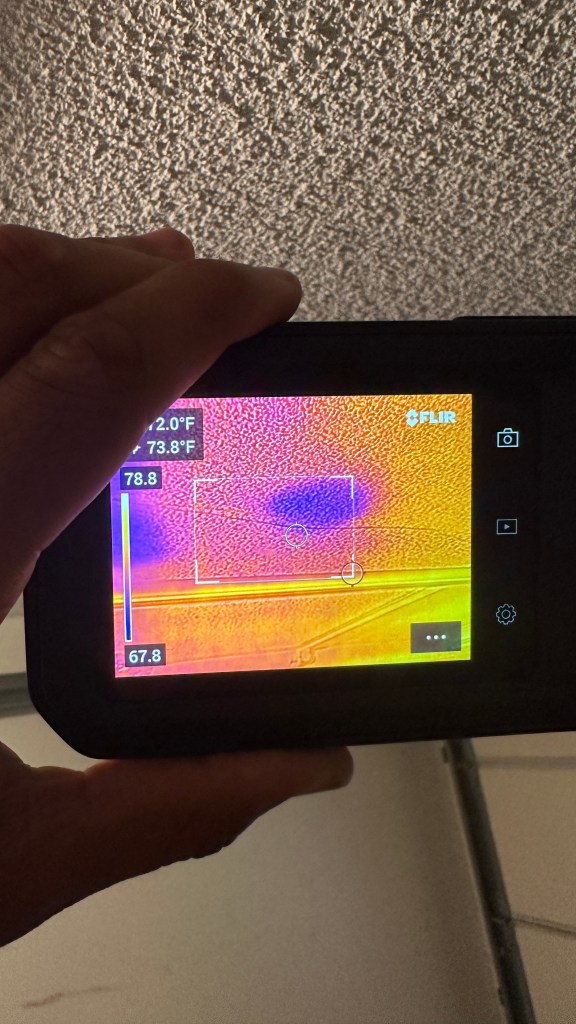
A water leak does not always leave a visible stain. Sometimes the drywall looks perfect. The floor feels dry. The paint is not bubbling. But moisture is already spreading behind the walls.
That is why restoration professionals rely on thermal imaging inspections for water damage to find problems before they become expensive repairs.
What Is Hidden From View
One of the biggest challenges after a leak is determining how far the water has traveled. Water rarely stays where it started.
A pipe leak behind a bathroom wall can spread into adjacent rooms. A roof leak can travel along rafters before showing up on a ceiling. Water from a failed appliance can move beneath flooring and into wall cavities.
Finding all that hidden moisture without opening every wall would be nearly impossible. Without thermal imaging, technicians would have to rely on a «poke and hope» method with a moisture meter, requiring 30 to 40 measurements for just one room .
This is where thermal imaging comes in.
How Thermal Cameras Find Hidden Moisture
Contrary to popular belief, thermal cameras do not actually see water. They detect temperature differences .
When building materials become wet, they cool differently than dry materials. As moisture evaporates, it creates subtle temperature changes that appear on a thermal image.
These cooler areas often reveal hidden water that cannot be seen with the naked eye . Studies show that thermal imaging can detect water infiltration even with thermal gradients as small as 0.4 to 1.5 °C, where affected areas appear with lower temperatures due to the thermal inertia of water .
Using infrared moisture detection, technicians can quickly identify suspicious areas behind drywall, under flooring, above ceilings, and around plumbing systems.
Real Life Example: Home in Pasadena
A homeowner in Pasadena noticed a small brown stain on the living room ceiling. He assumed the leak was minor. The ceiling felt dry to the touch. He saw no other signs.
When the restoration team arrived, they used a thermal imaging camera to scan the ceiling and walls. The thermal image showed a large cold area extending far beyond the visible stain. Water had spread along the floor joists four feet in each direction from the stain. It had also traveled down the wall cavity and pooled behind the baseboard.
Without thermal imaging, the homeowner would have painted over the stain while water continued to damage the joists and wall from the inside. The thermal camera revealed hidden moisture that no one could see.
IICRC Standards and Thermal Imaging
The IICRC S500 standard, which is the industry benchmark for water damage restoration, requires the use of a combination of methods to identify and quantify moisture in affected materials .
According to the standard, professional restorers must use:
- Penetrating moisture meters to measure moisture content in solid materials such as wood framing, plywood, and concrete slabs
- Non-invasive (radio frequency) moisture meters to detect moisture behind surfaces without creating holes
- Thermal (infrared) imaging to identify evaporative cooling patterns indicating moisture in hidden spaces
- Temperature and relative humidity logging to track drying conditions
Thermal imaging does not measure moisture directly but instead guides targeted moisture meter readings . Moisture readings must be taken at multiple points in each affected room, not just in areas of visible damage, because water migrates laterally and vertically through building materials .
IGM Technology: Thermal Camera and Moisture Meter in One Device
Modern tools such as the FLIR MR176 combine a thermal imaging camera and a moisture meter in one device using Infrared Guided Measurement (IGM) technology .
This approach allows technicians to:
- Quickly scan large areas with the thermal camera to identify cold spots
- Confirm the presence of moisture with the built-in moisture meter at the same points
- Create documentation that includes both thermal images and moisture readings
IGM tools also include a laser pointer for precise indication of the problem area detected by the thermal camera and can display moisture readings directly on the thermal image .
Scientific Basis of Thermal Imaging
Research confirms the effectiveness of infrared thermography for moisture monitoring in building materials .
Key research findings:
- Infrared thermography has shown itself to be a promising technique for moisture monitoring in building materials
- Quadratic models work well for predicting moisture content in materials with high porosity
- Thermography allows for estimating evaporation rate and moisture content
- The method is more effective for detecting moisture in materials with higher porosity
Studies have also shown that neural network models can predict material moisture content based on surface temperature with a coefficient of determination above 0.96 and an error of less than 5 percent .
Faster Detection Means Faster Drying
The earlier hidden moisture is found, the easier it is to remove.
Without thermal imaging, technicians might miss wet insulation, trapped moisture behind cabinets, or water beneath tile flooring.
These hidden pockets can eventually lead to:
- Mold growth
- Drywall deterioration
- Wood rot
- Flooring damage
- Poor indoor air quality
Thermal imaging helps restoration companies create a complete moisture map before drying even begins. This is especially important in commercial buildings where the scale of damage can be significant and downtime is expensive.
More Accurate Restoration
Thermal cameras also help determine where drying equipment should be placed.
Instead of guessing, technicians can focus air movers and dehumidifiers exactly where moisture exists.
This improves efficiency, shortens drying times, and helps prevent secondary damage. It also reduces unnecessary demolition because crews can target affected areas rather than opening large sections of walls or floors.
When thermal imaging is used with a moisture meter, the moisture detection process is significantly accelerated, eliminating blind testing that could miss entire zones of damage .
Real Life Example: Commercial Building in Torrance
A commercial building manager in Torrance noticed a damp spot on the ceiling in the hallway. The leak appeared to be small. He planned to simply replace the damaged ceiling tile.
The restoration company used a thermal imaging camera and discovered that water had traveled through the ceiling along steel beams and accumulated above the drop ceiling over an area of more than 200 square feet. Moisture had also penetrated the walls on both sides of the hallway.
The thermal camera showed that water had traveled far beyond the visible spot. If the manager had simply replaced the tile, moisture would have remained above the ceiling, leading to mold growth and corrosion of the steel beams. The thermal inspection allowed for targeted drying and prevented structural damage.
Thermal Imaging Is Only Part of the Process
Professional restorers always verify thermal images with moisture meters and other testing equipment .
A cold spot may indicate moisture, but it can also be caused by:
- HVAC ducts carrying cold air
- Missing or damaged insulation in the wall cavity
- Drafts
- Metal pipes inside walls
- Shadows or reflections from other objects
That is why experienced technicians combine thermal imaging with moisture readings to confirm exactly what is happening inside the building.
As thermography expert Tom Rochenske explains: «We are all guilty of oversimplifying this distinction, and it may sound like nitpicking. But it is important to remember that other factors can create cold spots on a thermal image» .
How Thermal Cameras Help With Insurance Claims
Thermal images also serve as important evidence for insurance companies because they:
- Provide visual proof for insurance adjusters
- Help clients understand the extent of the damage
- Accelerate the insurance claim approval process
- Reduce the number of reinspections
- Create an archive of evidence for effective drying
Many modern thermal cameras also take simultaneous visible light images, which helps add context and makes thermal images easier to understand without carrying a separate camera .
Some cameras can even overlay moisture meter readings onto the thermal image via Bluetooth, further strengthening the evidence base .
In one case in Beverly Hills, an insurance adjuster initially denied part of the claim, stating that the damage was limited to the visible area. The restoration company provided thermal images showing hidden moisture in adjacent walls and under the floor. The insurance company reconsidered its decision and approved the full amount.
Limitations of Thermal Imaging
Thermal cameras have limitations that are important to understand. They are effective for materials with high porosity, such as brick, but less effective for materials with low porosity, such as concrete and limestone, where they can only detect moisture in the near-surface zone .
That is why professional restorers always use thermal cameras in combination with moisture meters and other tools.
The Bottom Line
Water damage is often much larger than what appears on the surface. Using thermal imaging inspections for water damage and advanced infrared moisture detection technology, restoration professionals can quickly locate hidden moisture, create accurate drying plans, and help prevent mold and structural damage before they become major problems.
Thermal imaging, verified with moisture meters in accordance with IICRC S500 standards, allows restorers to:
- Detect moisture behind walls and under floors without demolition
- Create accurate moisture maps for targeted drying
- Document damage for insurance claims
- Confirm complete drying before work is completed
- Reduce restoration time and cost
Because when it comes to water damage, the most expensive moisture is usually the moisture you cannot see.
Professional restoration companies like Ursa Pro use thermal imaging cameras, moisture meters, and other diagnostic tools to detect hidden moisture and document damage across all 30 Los Angeles cities. Do not let hidden moisture catch you off guard. Inspect with thermal imaging. Measure with moisture meters. Dry properly.
 ursapro
Оставить комментарий