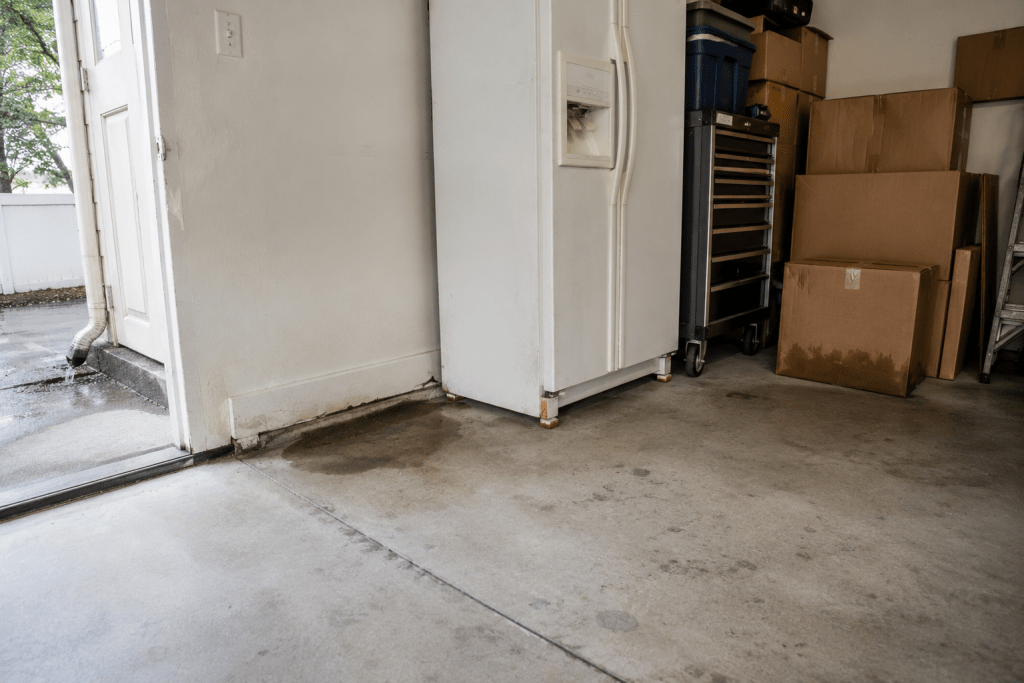
On the 200 block of North Gertruda Avenue in Redondo Beach, just half a mile from the ocean, stands a house built in 1976. It is a two story building with white stucco and a two car garage. An older couple bought it twenty years ago, in 2004, and they loved their garage very much. It held tools, boxes of Christmas decorations, an old bicycle, and two refrigerators.
The owners never noticed any water in the garage because there was no water in the usual sense. Instead, there was dampness, a dark stain on the concrete floor near the wall, and rust on the refrigerator legs. There was also a smell, sweet and earthy, that appeared after every rain. «An old house,» the husband would say. «In Redondo, it is always damp. We live by the ocean.» He was half right. The dampness was indeed there, but the cause was not the ocean.
How the house was built
The 1976 house had a typical construction for its time. The foundation was a concrete slab four inches thick, about ten centimeters. Beneath the slab lay a layer of sand and gravel and then a bed of dense clay, which is typical for Redondo Beach and does not drain well. When the soil becomes saturated, water does not go deeper but stays in the upper layers, creating pressure against the slab from below.
Outside, along the garage wall, there was a concrete walkway thirty centimeters wide. It had been poured in 1976 and had never been repaired. Over nearly fifty years, the concrete had cracked. The cracks ranged from two millimeters to one centimeter wide, and through them, water freely seeped downward, under the foundation.
A downspout from the roof came out right at the corner of the garage. The owners had redirected it there themselves in 2010 when they were redoing a flower bed, and the downspout ended up only fifteen centimeters from the wall. They did not know that building codes require a minimum distance of at least two meters.
What happened every time it rained
The rainy season in Redondo Beach lasts from November through March, and during this time, an average of about three hundred millimeters of rain falls. Storms here can be strong, with up to twenty five millimeters per hour.
Every time it rained, water from the downspout poured directly onto the ground at the foundation. In one hour of heavy rain, about a thousand liters of water came out of the downspout, and the dense clay could not absorb it quickly. As a result, puddles up to five centimeters deep formed against the wall and stayed there for two or three days, because clay absorbs moisture extremely slowly.
Through the cracks in the walkway, water traveled under the garage slab, and the clay beneath the slab gradually became saturated. When the soil is completely wet, it stops absorbing, and each new rain adds more water on top while the old water remains trapped. This created hydrostatic pressure. The saturated soil pushed against the concrete slab from below with a force of several tons per square meter, and the moisture began looking for a way out. It found micro cracks in the concrete, pores, joints, and gaps around pipes, because concrete is not waterproof and even a good quality slab allows moisture to pass through its capillaries.
A dark damp stain appeared on the floor surface. It was never large, at most thirty by thirty centimeters. It dried up a couple of days after the rain stopped, and the owners thought it was just condensation. But it was not dew. It was groundwater rising from below.
Three years of invisible destruction
The problem did not start the day the couple bought the house. It started in 2010, when they redirected the downspout. From that moment on, every rainy season added moisture under the slab, and for the first two years, there were no visible signs because the clay stored water slowly.
In the third year, the first signs appeared. The owners noticed that the garage floor darkened after rain, but they paid no attention.
In the fourth year, rust began to appear on the legs of the refrigerator, which sat directly on the concrete without any padding. Moisture rose through the slab and settled on the metal. First came tiny orange spots. After six months, the rust had eaten through the enamel. After another year, the legs became brittle. When the owners tried to move the refrigerator, one leg broke off, the refrigerator tipped, and they had to buy a new one.
In the fifth year, mold appeared in the cardboard boxes of documents that sat on the concrete floor in the corner of the garage. Moisture rose through the slab and soaked into the cardboard. At first, the boxes just smelled damp. Then dark stains appeared on them. Then white fuzzy growth covered old photographs and tax returns. When the owners tried to lift the boxes, the bottoms had softened and crumbled. Photographs stuck to the cardboard. The documents had to be thrown away.
That same year, tools in a metal chest began to rust. The chest sat on the floor, moisture condensed on the cold metal, and wrenches and screwdrivers darkened. The drill stopped working because moisture had penetrated inside the housing and shorted the contacts. The owners took the drill to a repair shop, but the technician said the repair would cost more than a new drill.
Wooden shelves along the wall began to rot from the bottom. Their legs stood directly on the concrete, absorbed moisture, swelled, and became covered with black spots. When the husband tried to move the shelves to sweep the floor, one leg broke. The shelves collapsed. Paint cans broke open, leaving a gray puddle on the floor.
The wall shared with the house began to emit an odor that traveled into the entryway. The wife smelled it every morning. She bought a scented candle, but the smell only became slightly sweeter without disappearing. By autumn, the odor had grown so strong that guests would walk in and ask, «Did something leak here?» The owners dismissed the question, but unease had settled into the home.
How they found the problem
Six years after the owners redirected the downspout, and three years after the first signs appeared, during an especially strong winter storm, water appeared in the garage for the first time as a small puddle of about half a liter, sitting right in the middle of the garage, half a meter from the wall.
The owners finally called an inspector. He arrived with a thermal camera and a moisture meter. He examined the garage, then went outside to assess the downspout, the cracks in the walkway, and the slope of the yard. When he returned to the garage, he knocked on the concrete floor. The sound was dull, not sharp.
The inspector measured the moisture content of the floor. In the wettest spot, it was twenty two percent, while the normal range for dry concrete is below twelve percent. The moisture content of the soil under the slab, measured through a small borehole, reached eighty percent.
The inspector explained to the owners that they had hydrostatic pressure. The soil beneath the garage was oversaturated. Water was coming not from above but from below, through the concrete slab. The floor was wet not because something had been spilled on it but because it was sweating groundwater, which often happens when a house sits on clay and drainage is poorly managed. The problem had been developing for several years, and by then, moisture had already risen six centimeters up the walls. If nothing was done, the floor would begin to deteriorate within a year, and within two years, the garage foundation could settle.
Four mistakes that led to the flooding
The first mistake was that the downspout dumped water only fifteen centimeters from the foundation, when building codes require a minimum distance of at least two meters. Over six years, thousands of liters of water had passed through that downspout, gradually saturating the soil beneath the garage.
The second mistake was that the walkway had cracked and no longer diverted water. The cracks remained open, and water traveled straight under the slab, whereas a properly sealed walkway would have directed water away.
The third mistake was the slope of the yard behind the garage. The ground had a slight tilt toward the house instead of away from it, just two degrees, but that was enough to keep rainwater constantly pooling against the foundation wall.
The fourth mistake was the complete lack of ventilation in the garage. Humidity inside stayed at seventy percent year round, and the moisture rising through the floor had no way to escape. Instead, it condensed on walls and ceiling, settling on metal objects and cardboard boxes.
How they fixed it
The repairs took one week and cost seven thousand dollars. Three people worked on it: the inspector, a plumber, and a builder.
On the first day, workers dug up the downspout, removed the old discharge pipe, and installed a new pipe six meters long. It now feeds into a drainage pipe one hundred millimeters in diameter, buried thirty centimeters underground. The drain empties into the street five meters from the garage, directly into the city storm sewer system, so rainwater from the roof now goes into the municipal system.
On the second day, they repaired the walkway. All cracks were widened with a grinder, cleaned of dust, and filled with polyurethane sealant, which remains flexible and does not crack when the ground moves. On top, they applied a deep penetrating concrete sealer that closes the pores in the concrete and prevents water from seeping through.
On the third day, they regraded the yard behind the garage. They removed the top layer of sod, added five tons of sand and gravel, and compacted everything with a vibrating plate. Now the slope away from the house is three degrees, and water flows toward the fence, not toward the foundation.
On the fourth day, they installed forced ventilation in the garage. They drilled two holes in the wall, one low near the floor for intake and one high under the ceiling for exhaust. On the exhaust side, they installed a fan with a humidistat that turns on automatically when humidity exceeds fifty percent. The fan runs quietly, barely audible.
On the fifth day, they applied epoxy waterproofing to the concrete floor. First they sanded the floor to open the pores, then applied a primer, then two coats of epoxy resin mixed with quartz sand. The epoxy penetrates up to five millimeters into the concrete pores and seals them. The floor stopped sweating and became smooth and shiny.
On the sixth day, they installed a sump pit with a drain pump. They cut a square hole in the floor, fifty by fifty centimeters, excavated a pit sixty centimeters deep, and installed a plastic basin with a pump equipped with a float switch. When water rises to a certain level, the pump turns on automatically and discharges the water into the drainage pipe. The pump can move up to three thousand liters per hour.
On the seventh day, the owners threw away all the cardboard boxes and bought plastic containers with tight fitting lids. They placed a two centimeter thick rubber mat under the refrigerator. They moved their tools into a plastic chest and sent the old metal chest to scrap. The rotten wooden shelves were replaced with plastic ones.
Who this story is for
If your home is in Redondo Beach, Hermosa Beach, Manhattan Beach, Torrance, Palos Verdes, or any other place with high groundwater and clay soil, your garage or basement is at risk. This is especially true for houses built before 1990, in which foundation waterproofing is often missing or has deteriorated over decades.
Pay attention to these signs. The concrete floor darkens after rain. White powdery stains appear on the walls, a phenomenon called efflorescence. Tools rust for no visible reason. The garage smells musty. Cardboard boxes feel soft to the touch.
If you notice even one of these signs, do not wait for puddles to appear. Do not hope that everything will dry out on its own. Do not tell yourself it is just condensation. Call a specialist who can inspect the waterproofing, drainage, and ventilation.
In Los Angeles, companies handle these problems. They will find the crack in the walkway, the improper slope, the leaking downspout, or the hydrostatic pressure under the slab. They will do what you cannot see with your own eyes. They will see water where it should not be. They will measure the moisture content of the concrete and the soil and tell you whether you need a sump pump or just a repaired walkway.
Because water in a garage or basement almost never starts with a flood. It starts with a small stain that you decide not to notice. And it ends with seven thousand dollars in repairs, a thrown out refrigerator, ruined documents, and broken tools
 ursapro
Оставить комментарий