1. Insurers refuse to pay for complete toxin cleanup
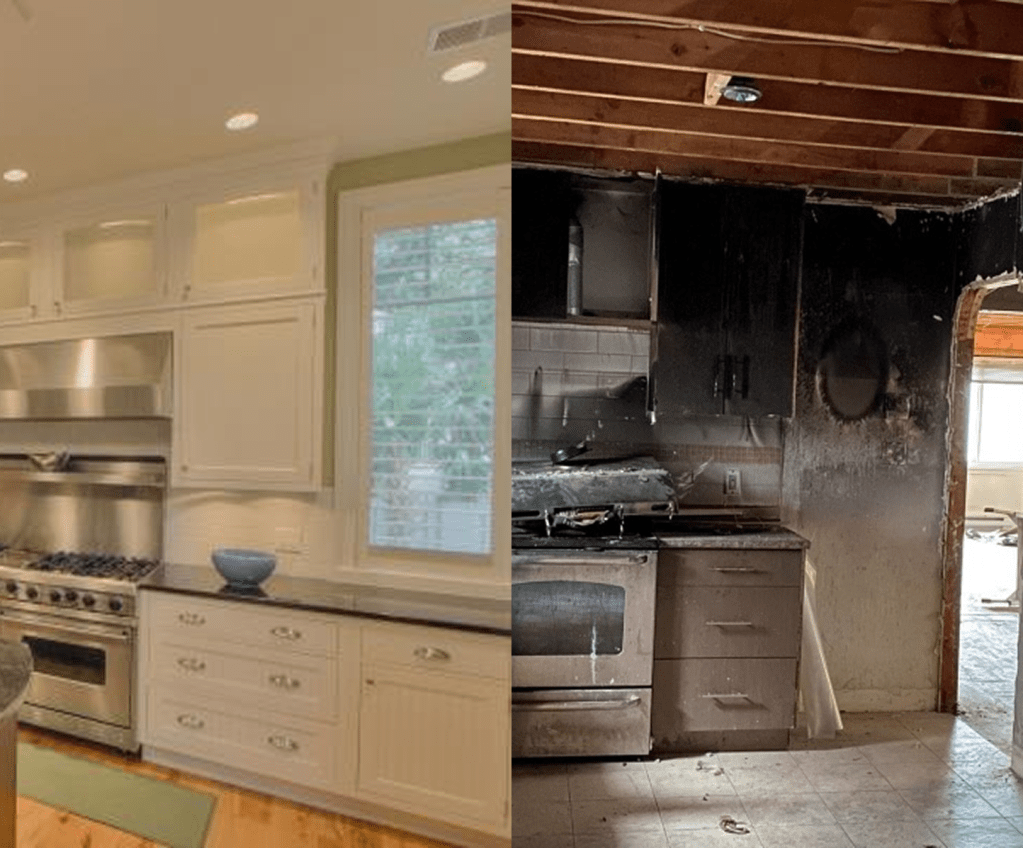
The problem. After house fires, dangerous substances remain inside the home. Lead, asbestos, and heavy metals. Insurance companies often refuse to test for these toxins. Or they only pay for superficial cleaning.
After the Eaton Fire in California (January 2025), thousands of homes remained standing but were saturated with toxic smoke. Resident Amy Harritty paid $7,000 out of her own pocket for testing and sealing her home. Tests showed lead and asbestos. Her insurer, State Farm, offered to pay only about half of the $102,000 that their own contractor estimated for proper cleanup. Six months after the fire, Harritty’s home still had untouched school lunches she packed on the night of evacuation.
According to the Eaton Fire Residents United group, 100% of tested homes showed lead contamination before remediation. After professional cleaning paid for by insurance, 60% still tested positive for lead and other toxins.
2. Incomplete electrical wiring replacement after a short circuit fire
The problem. A fire often starts with a short circuit. But insurers try to exclude coverage for the electrical system damage itself. They offer to pay only for damage caused by the «ensuing fire.»
In Glens Falls Insurance Co. v. Beachcrest of Hollywood, Inc., a short circuit caused a fire. The insurance company argued that damage to the entire electrical system was caused by an «electrical disturbance» rather than fire, and therefore was not covered. The court ruled that the full electrical replacement was necessary because of the fire. The insurer was ordered to pay the full repair cost of $2,616.01.
Important note. Many policies include a clause. If a short circuit leads to a fire, the insurer is responsible only for damage from the «ensuing fire,» not the damaged wire itself. However, courts are increasingly ruling for homeowners, finding that without full wiring replacement, the home is unsafe.
3. Denial of coverage for necessary upgrades during restoration
The problem. After a fire, the home must be restored to «like kind and quality.» Insurers refuse to pay for any improvements. Better insulation. Finished basements. Even when these upgrades are necessary for a proper repair.
Real case. In Hall v. New York Central Mutual Fire Insurance Co. (2022), homeowners sued their insurance company. The insurer refused to pay for replacement of damaged structures and for upgrades including partial basement finishing and improved insulation. The court sided with the insurer. The ruling stated that coverage only applies to restoration of «like kind and quality.» Any improvements must be paid for by the homeowner.
4. Mold after firefighting water damage and how insurers avoid responsibility
The problem. The water used to put out the fire floods the home. If repairs take too long, mold begins to grow. Insurance companies often claim that mold is an «excluded risk.» Even when the mold developed directly from a covered event (the fire).
Real case. In Jackson v. Travelers (MDD District Court), water from a leaking toilet (a covered event) led to mold growth. Travelers tried to deny mold damage coverage by citing the policy’s «mold exclusion.» However, the court ruled differently. If water damaged drywall to the point where it lost structural integrity (softened or delaminated), that damage is covered as «water damage,» regardless of whether mold is present. Mold is a consequence, not the primary cause.
5. Insurance subcontractors minimize toxic contamination findings
The problem. Insurers hire «independent» experts to perform testing. But these experts use methods designed to minimize payouts, not to detect real hazards.
Real case. An investigation by the Smoke & Mirrors podcast (Consumer Watchdog) revealed a systemic problem. Companies like HRA Environmental Consultants and Blue Sky Environmental are regularly hired by State Farm and Amica to assess smoke damage. In one case, a consultant admitted under oath that he based his «clean» conclusion solely on visual inspection and smell. He did not perform deep testing for heavy metals. In another case, the same expert explained away toxins in a home located 25 miles from the ocean by blaming «sea spray.»
Summary for homeowners
If you feel that repairs were done poorly or the insurance adjuster gave a «green light» too quickly, here is what you can do.
- Demand independent air and wipe testing. Test specifically for lead, asbestos, and combustion byproducts.
- Read your policy carefully. Look for language about «ensuing loss.» This clause can help you obtain coverage for upgrades or mold remediation.
- Document every denial in writing. This creates evidence for a potential bad faith lawsuit against the insurer.
Need an independent post repair inspection?
A completed insurance claim does not mean every issue was fixed. Ursa Pro Restoration offers independent post repair inspections to identify hidden defects before they become costly problems.
Our specialists use professional moisture meters, thermal imaging technology, and visual inspections to find what insurance repairs may have missed.
Serving Malibu, Pacific Palisades, Santa Monica, Brentwood, Topanga, Calabasas, and surrounding Los Angeles communities.
 ursapro
Оставить комментарий