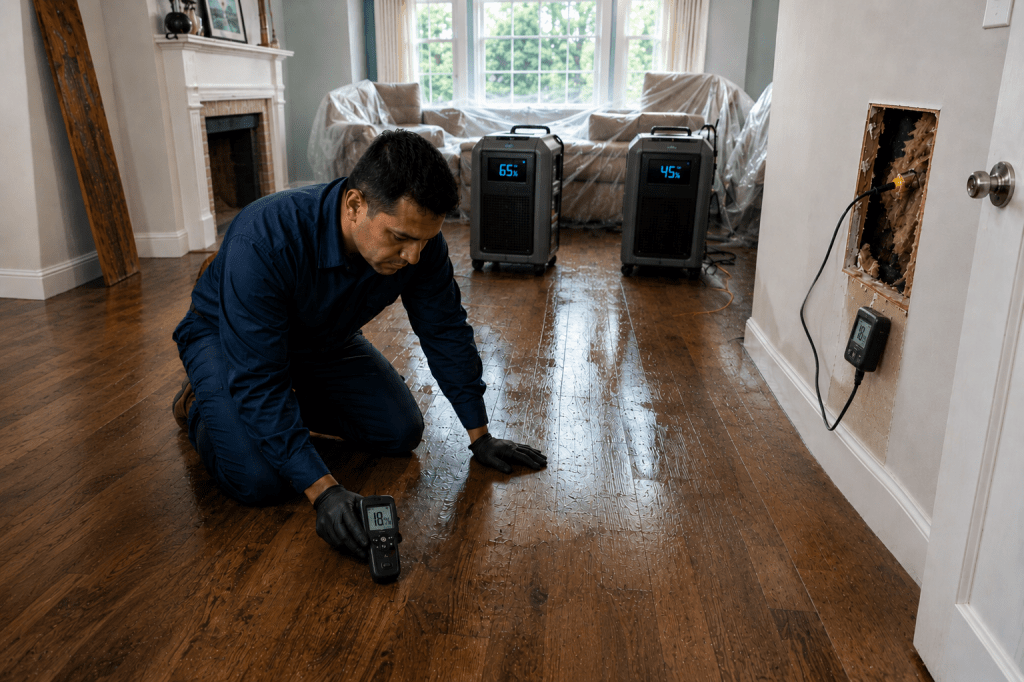
Professional structural drying is impossible without the right equipment. While a homeowner might set up a floor fan, professionals use complex systems designed to control airflow, temperature, and humidity with scientific precision.
Equipment Used in Commercial Drying
Every commercial drying project relies on a combination of specialized equipment.
Air Movers. High velocity fans designed to accelerate evaporation. They create controlled airflow patterns across wet surfaces and inside structural cavities.
These machines are not like household fans. Industrial air movers create airflow at speeds up to 3000 feet per minute. They are positioned strategically, at angles to walls and floors, to create a continuous air circulation that strips away the saturated boundary layer.
Refrigerant Dehumidifiers. These systems cool incoming air below its dew point, condensing moisture into liquid water that is collected and removed.
A standard refrigerant dehumidifier can remove 50 to 150 pints of water from the air per day. For comparison, a household dehumidifier might remove 10 to 20 pints.
Desiccant Dehumidifiers. Used for severe drying projects. These systems use moisture absorbing materials to pull water vapor from the air and are especially effective in cold conditions or for large commercial spaces.
Specialty Drying Systems. Professionals may use floor drying mats, wall cavity injection systems, hardwood floor drying panels, and directed heat systems. These technologies allow materials to dry without unnecessary demolition.
Why Structural Drying Matters
Water damage is not static. Every hour moisture remains trapped inside building materials increases the risk of mold growth, wood rot, delamination, corrosion, structural weakening, and indoor air quality problems.
Mold can begin developing within 24 to 48 hours after water exposure. The faster moisture is removed, the lower the overall restoration cost and risk.
The Goal: Drying Without Demolition
Modern restoration science focuses on preserving as much of the structure as possible. Through proper psychrometric calculations, moisture monitoring, and specialized equipment, many materials can be successfully dried without extensive removal.
This saves time, money, building materials, and insurance costs. But it only works when drying is based on science, not assumptions.
When Drying Is Possible and When It Is Not
Not all materials can be dried.
Can be dried.
- Wood framing
- Concrete slabs
- Brick masonry
- Hardwood flooring (with fast response)
- Drywall (only with light wetting and fast response)
Cannot be dried (requires replacement).
- Fiberglass insulation (after saturation)
- Cellulose insulation
- Carpet padding
- Insulation with paper backing
- Heavily contaminated drywall
- Materials with mold growth
IICRC S500 target moisture levels: wood framing must be dried to 14 percent or below, concrete slabs must have moisture readings matching baseline before flooring can be installed.
A Real Example from Los Angele
Pasadena — Attic After a Roof Leak
A homeowner in Pasadena noticed a small brown stain on the bedroom ceiling after a winter storm. A roofer fixed the leak. The stain was painted over. The homeowner assumed the problem was solved.
Six months later, his daughter began experiencing asthma symptoms. Nighttime coughing. Congestion. She was using her inhaler more often.
An inspection revealed the problem. Water from the old leak had not soaked through the drywall. It had soaked into the cellulose insulation in the attic. The insulation, which should have been fluffy and loose, had turned into a hard, compressed layer only a few inches thick. It was black with mold.
The attic insulation mold had been releasing spores through gaps in the ceiling and around light fixtures. The bedroom below was pulling in contaminated air every night.
Removing the insulation cost $2,800. New insulation added another $2,200. After the work was completed, the daughter’s asthma symptoms improved significantly.
Professional restoration companies like Ursa Pro use science based structural drying across all 30 Los Angeles cities to save materials rather than replace them. Do not let hidden moisture rot your framing. Trust the science. Dry correctly.
 ursapro
Оставить комментарий