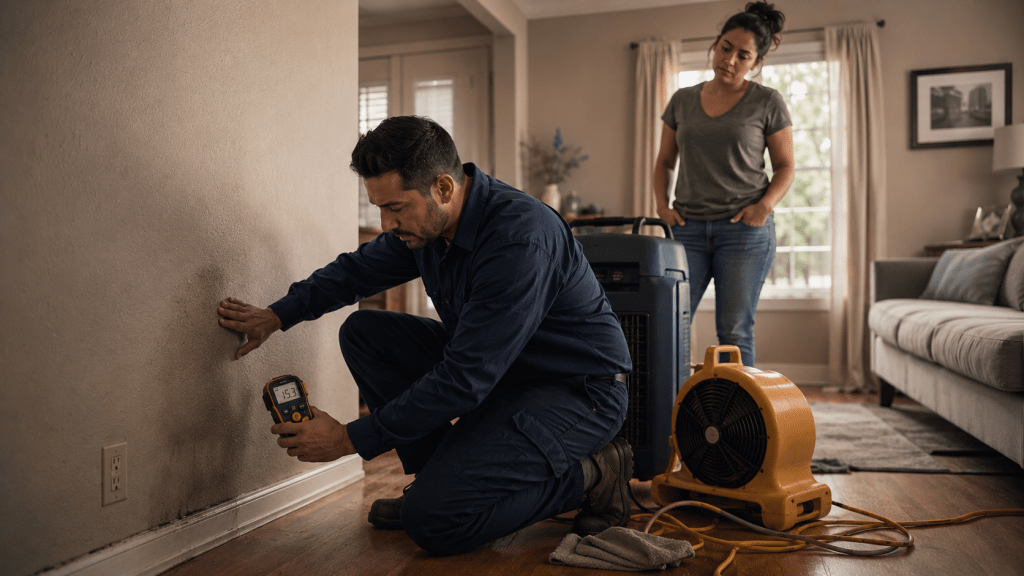
Let’s look at what actually happens to homeowners in this state. Not hypotheticals. Real addresses. Real numbers.
Leucadia, San Diego County — Six Slab Leaks in Three Years
On a quiet street in Leucadia, just off the 101 highway, an 11-unit apartment building at a property called Hillcrest Apartments became a cautionary tale. The owner, Harry Guzelimian, was trying to maintain affordable housing for low-income Hispanic families. But over three years, the building experienced more than half a dozen slab leaks .
Each leak meant flooding. Each flood meant pulling out carpets and cabinets. And then came the mold — the worst part, Guzelimian said. He had to move every tenant into hotels. Insurance didn’t cover everything because of mold limitations. He paid the balance out of pocket .
One hot water slab leak flooded the downstairs units so badly that it turned into a full-scale mold remediation job. The alternative to a permanent fix was repiping the entire building — which would have taken three weeks and displaced every family. That’s three weeks of hotel costs. Three weeks of lost rent. Three weeks of tenants’ lives upended .
Source: San Diego Plumbing and Pipe Lining Company case study
Rancho Peñasquitos, San Diego — A 36-Inch Water Main Break
Off Black Mountain Road in Rancho Peñasquitos, near the entrance to Black Mountain Open Space Park, a 36-inch water transmission main burst in August 2024. This wasn’t a small leak — it was a municipal disaster big enough that the City of San Diego had to bring in heavy excavation equipment just to find the break .
Neighbors on Wescott Court watched water flow into their backyards for weeks. John Jaskowiak, a resident, told CBS 8 that water was running into his yard until the city finally started repairs. Downstream on Wescott Court, three next-door neighbors had to dig trenches in their own backyards to pump water out to the street .
The city’s repair crews worked around the clock. The fix took days — not hours. And for homeowners in the path of that water, the damage was already done before the first shovel went into the ground .
Sources: CBS 8 San Diego , City of San Diego public works statements
Camarillo, Ventura County — The High Water Table Problem
Drive through Mission Oaks, Las Posas, or central Camarillo, and you’d never guess what’s happening under the foundations. Camarillo sits on clay-heavy soil above a naturally high water table. When rainy seasons hit, groundwater doesn’t drain — it pushes upward, straight into slab foundations and crawlspaces .
Restoration crews have inspected crawlspaces in Mission Oaks reading 90%+ humidity. Slabs with active moisture seepage. Insulation damp from below. And here’s the kicker: most of Camarillo’s homes were built in the 1970s, when builders didn’t install vapor barriers under slabs, left crawlspace vents sealed, and graded drainage poorly .
The result? Mold growing from the ground up, behind drywall, under flooring — invisible until floors buckle or family members start having unexplained breathing issues. One Camarillo Heights homeowner told a restoration crew they’d been smelling «something musty» for two years before they finally cut into a wall and found black colonization from floor to ceiling .
Source: Total Restoration Ventura County case documentation
Westwood, Los Angeles — A Child Care Center Leaking from the Top
At UCLA’s Child Care Center in Westwood, located on the top floor of the Westwood Marketplace, water was leaking into the building. Not a pipe — the roof. Water was entering through mechanical penthouse assemblies and walls, dripping down into spaces where young children spent their days .
Simpson Gumpertz & Heger, the engineering firm hired to investigate, performed water testing and exploratory openings to document the existing construction. The fix required replacing mechanical penthouse roofs, performing localized roof repairs, and applying elastomeric coating to the penthouse walls. A construction administration team had to oversee every stage because one missed detail would mean more water — more mold risk — more days the center couldn’t operate safely .
Source: Simpson Gumpertz & Heger project portfolio
What These Cases Have in Common
Every single one of these homeowners had the same thought at some point: it’s probably fine.
The apartment owner in Leucadia didn’t plan for six slab leaks. The families in Rancho Peñasquitos didn’t expect a city water main to flood their yards. The Camarillo homeowner didn’t know about the high water table when they bought the house. UCLA didn’t build a child care center expecting roof leaks.
But water doesn’t care about your plans. And the longer you wait, the more zeros get added to the bill.
The apartment owner in Leucadia paid for mold remediation out of pocket because insurance capped mold coverage. The families on Wescott Court dug their own trenches because the city’s response time meant days of standing water. The Camarillo homeowner lived with a musty smell for two years — and ended up replacing entire walls instead of just drying a small patch.
What You Can Learn From Them
Here’s the difference between these homeowners and you: you’re reading this now.
You don’t have to wait for six slab leaks. You don’t have to dig a trench in your backyard. You don’t have to wonder why your family keeps coughing. U should call to professional before is too late
One moisture meter reading today can prevent a $30,000 mold remediation next year. One professional drying job can save your floors, your air quality, and your peace of mind.
The question isn’t whether your home has moisture somewhere it shouldn’t. The question is whether you’ll find it — or it’ll find you.
 ursapro
Оставить комментарий